
Understanding Wire-Supported Dust Collection Hose
When choosing a vacuum hose for dust collection, the way the hose is constructed matters. Different hose styles are designed for different jobs, and a hose that works well for general shop cleanup may not be the best choice for connecting to planers, saws, separators, blast gates, or installed dust collection systems.
One hose style that continues to play an important role in dust collection is wire-supported hose.
Wire-supported hose has been used for years in vacuum and dust collection applications because it provides flexibility, airflow, and strength in larger-diameter systems. While many modern wet/dry vacuums now ship with blow-molded or vacuum-formed plastic hoses, wire-supported hose remains a popular choice for dust collection setups where airflow and durability matter.
What Is Wire-Supported Hose?
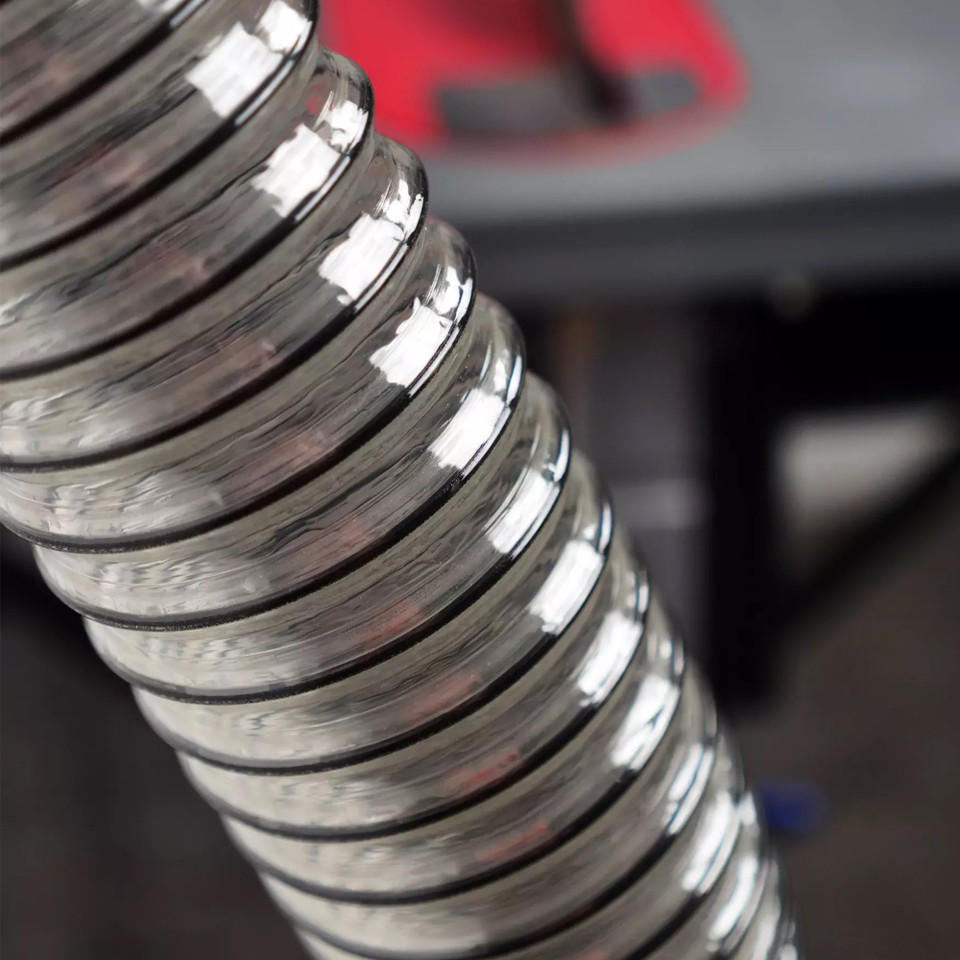
Wire-supported hose is made with a flexible plastic hose jacket supported by a spiral wire reinforcement. The wire helps the hose hold its shape while allowing it to bend and flex.
This construction is especially useful in dust collection because the hose needs to move around equipment, connect to ports and separators, and resist collapsing under suction.
Wire-supported hose is commonly used with:
- Dust separators
- Planers
- Shapers
- Routers
- Miter saws
- Table saws
- Blast gates
- Installed dust collection systems
- Large-particulate collection applications
Because these tools can generate larger chips, shavings, and debris, hose diameter and airflow are important.
Why Wire-Supported Hose Is Still Used in Dust Collection
Many shop vacuums today come with lightweight molded plastic hoses. These hoses are often acceptable for basic cleanup, but they are not always ideal for higher-airflow dust collection.
Wire-supported hose remains useful because it can provide:
- Better airflow in larger diameters
- Good flexibility
- Resistance to collapse under vacuum
- Compatibility with dust collection fittings
- Strong performance with separators and workstations
- The ability to compress for shipping and storage
For dust collection, especially when collecting larger debris from woodworking equipment, maintaining airflow is often more important than simply using the smallest or least expensive hose.
PVC vs. Urethane Hose Construction
Wire-supported hose is commonly made using either PVC or urethane as the hose jacket material.
PVC Wire-Supported Hose
PVC is often used when cost is the main concern. It is generally the lower-cost construction and is common in many basic dust collection hose offerings.
PVC hose can work for many applications, but it may not offer the same level of puncture resistance, wear resistance, or material performance as urethane.
Urethane Wire-Supported Hose
Urethane hose is generally considered the higher-performance option. It offers several advantages over PVC, including:
- Better puncture resistance
- Better wear resistance
- Better chemical resistance
- Improved durability in abrasive applications
- Better resistance to static surface charge compared with PVC
For applications where the hose may be dragged across a shop floor, connected to abrasive debris sources, or used frequently, urethane can provide a stronger long-term solution.
Why Cen-Tec Chose Urethane
Cen-Tec Systems selected clear polyurethane wire-supported hose for its dust collection hose program because the performance benefits outweighed the modest cost difference compared with PVC.
While PVC can be less expensive, the cost difference was small enough that urethane offered a better value based on material performance.
The goal was to provide a hose solution that could support serious dust collection applications rather than compete only on the lowest possible hose price.
Available Wire-Supported Hose Options
Cen-Tec’s wire-supported polyurethane hose options include 2-inch, 2.5-inch and 4-inch diameters in various lengths ranging from 6 foot to 50 foot.
97679 - 2 Inch x 10 Foot Urethane Ducting, Bridge Clamps, 2.25 Inch Adapters
97690 - 2 Inch x 10 Foot Urethane Ducting Hose with Four Bridge and Two Key Clamps
97712 - 2.5 Inch x 10 Foot Urethane Ducting Hose with Four Bridge and Four Key Clamps
90257 - 2.5 Inch x 6 Foot Quick Click Urethane Dust Collection Hose with Clamps
90258 - 2.5 Inch x 12 Foot Urethane Dust Collection Hose with Clamps
63316 - 2.5 Inch x 25 Quick Click Urethane Dust Collection Hose
63327 - 2.5 Inch x 50 Quick Click Urethane Dust Collection Hose
90259 - 4 Inch x 6 Foot Urethane Dust Collection Hose with Clamps
90260 - 4 Inch x 12 Foot Urethane Dust Collection Hose with Clamps
63338 - 4 Inch x 25 Quick Click Urethane Dust Collection Hose
63349 - 4 Inch x 50 Quick Click Urethane Dust Collection Hose
The 2-inch hose can be adapted to standard 2.25-inch dust collection connections using the appropriate fittings. The 2.5-inch and 4-inch hose are commonly used in dust collection applications and can connect to separators and other large-port equipment using band clamps.
Why Hose Diameter Matters
Dust collection systems place a premium on airflow. Larger hose diameters can support higher CFM, which can be important when collecting chips, shavings, and larger debris from woodworking equipment.
The 2.5-inch size is common in the dust collection market and is often used when connecting to separators, workstations, and larger vacuum ports.
The 2-inch size can also be useful, especially where fittings are available to connect to standard 2.25-inch blast gates or workstations. In some systems, a 2-inch hose may offer a practical balance between airflow, handling, and connection compatibility.
Understanding Turn-Key Clamps and Bridge Clamps
When working with wire-supported hose, the clamp style matters.
Because the hose includes a spiral wire reinforcement, a standard clamp must cross over the wire at some point. If the clamp does not seal evenly around the hose, there is a small potential for air leakage.
Two clamp styles are commonly used with this type of hose: turn-key clamps and bridge clamps.
Turn-Key Clamps
Turn-key clamps are easy to use because they can be tightened without a tool. This makes them convenient when hoses or fittings may need to be changed quickly.
A turn-key clamp will cross over the wire reinforcement at some point. With a tight-fitting adapter and a properly tightened clamp, this normally provides a secure connection.
Turn-key clamps are a practical choice when speed and convenience are important.
Bridge Clamps
Bridge clamps are designed specifically for wire-supported hose. The clamp band follows the channel between the wire ribs, while a small bridge crosses over the spiral wire.
This design helps reduce the possibility of air leakage where the clamp crosses the wire.
Bridge clamps require a tool to open and close, but they provide a more purpose-built clamping method for wire-supported hose.
Available Clamp Options
Cen-Tec offers clamp options for 2-inch, 2.5-inch and 4-inch wire-supported hose.
97833 - Six Pack of 2 Inch RH Bridge Clamps
97822 - Six Pack of 2 Inch Key Clamps
97811 - Six Pack of 2.5 Inch RH Bridge Clamps
97800 - Six Pack of 2.5 Inch Key Clamps
95919 - 4 Inch Right Hand Bridge Clamp (Single, 4-Pack and 10-Pack)
95853 - 4 Inch Stainless Key Clamp (Single, 4-Pack and 10-Pack)
Both clamp styles use stainless band material. The best choice depends on the application. Turn-key clamps are easier to remove and adjust, while bridge clamps are designed to better follow the shape of wire-supported hose.
Building a Complete Dust Collection Solution
Wire-supported hose is most effective when used as part of a complete dust collection setup. That may include:
- Hose
- Clamps
- Separators
- Blast gates
- Tool adapters
- Vacuum adapters
- Shop-vac connections
- Power tool hose connections
This is especially important because dust collection systems often require multiple connection sizes. A system may need to connect from a tool to a separator, from the separator to a vacuum, or from a hose to an installed collection line.
Using the right hose, clamps, and fittings helps maintain airflow and reduce connection problems.
The Right Hose for Larger Debris Collection
Wire-supported polyurethane hose is a strong option for users who need better airflow and durability than a standard molded shop-vac hose can provide.
It is especially useful in woodworking and shop environments where tools generate larger debris and where the hose needs to remain flexible while resisting collapse.
For users building or expanding a dust collection system, wire-supported hose can provide a reliable connection between tools, separators, and vacuum systems.
Cen-Tec Systems offers wire-supported hose, clamps, separators, and adapters designed to work together as part of a complete dust collection solution.