
How to Measure a Vacuum Port Before Ordering a Hose or Adapter
If there is one reason vacuum hoses and adapters get returned, it is simple: the fit was guessed instead of measured.
A port that “looks like” 1.5 inches may actually be closer to 1.25 inches. A hose cuff that seems like it should slide over a tool port may actually be designed to fit inside it. And two openings that appear almost identical can still be just far enough apart in size to create a loose connection, an air leak, or a part that will not fit at all.
Taking a few minutes to measure correctly before ordering can save time, avoid return shipping, and help you get the right connection the first time.
Why vacuum parts get returned so often
Most hose and adapter ordering mistakes happen because vacuum connections are not always labeled clearly. Many customers rely on brand names, rough estimates, or old part numbers instead of measuring the actual connection points.
That creates problems fast.
A shop vacuum hose may be listed as 1.25 inch, 1.50 inch, or 2 inch, but that number does not always tell you whether it is referring to the inside diameter of the hose, the outside diameter of the cuff, or the size of the port it is meant to fit. On top of that, manufacturers sometimes round dimensions, and some ports are slightly tapered rather than perfectly straight.
The result is familiar: a hose that is too loose, an adapter that will not seat fully, or a tool connection that only fits halfway. In many cases, the part itself is fine. The measurement method was the issue.
ID vs. OD and why the difference matters
When measuring vacuum connections, the two most important terms are ID and OD.
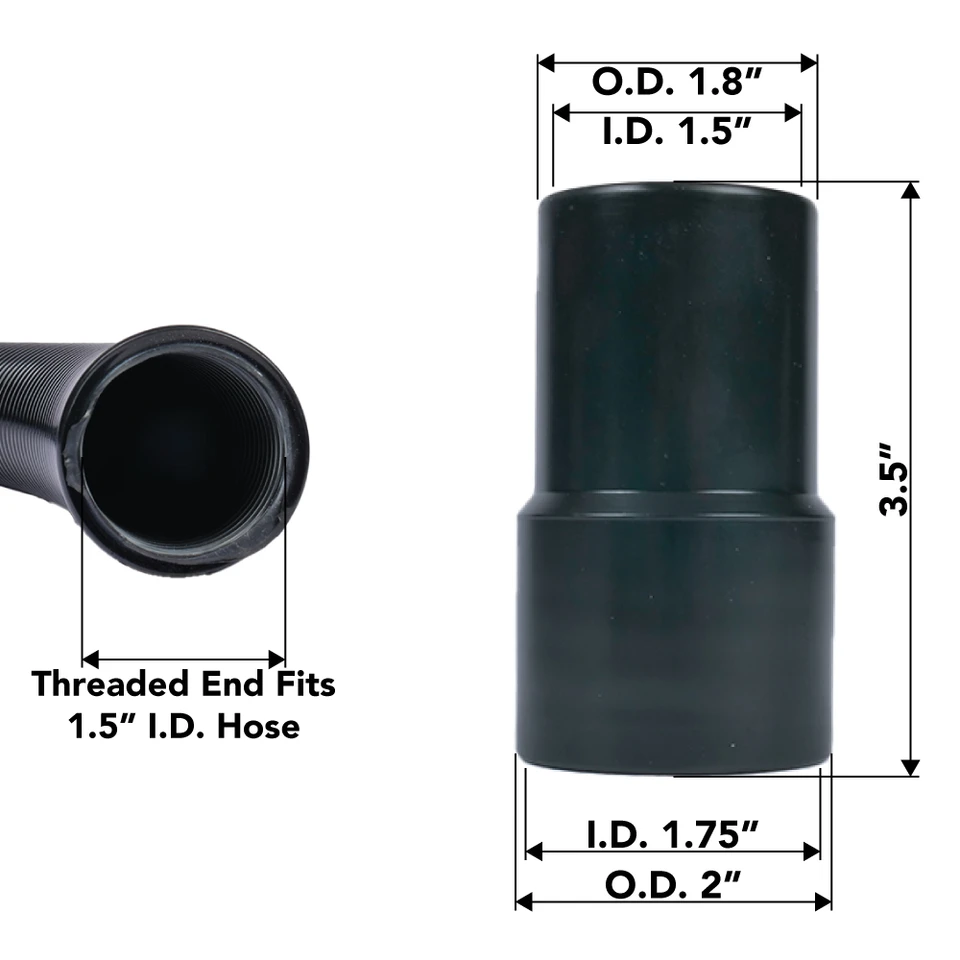
ID means inside diameter. This is the open space inside a hose, cuff, or fitting.
OD means outside diameter. This is the full width measured across the outside of a cuff, tool port, wand, or adapter end.
This matters because one part usually fits over another part or inside another part.
For example:
- If a hose cuff slides over a tool port, you usually need the inside diameter of the cuff and the outside diameter of the tool port.
- If an adapter inserts into a vacuum inlet, you usually need the outside diameter of the adapter and the inside diameter of the inlet.
- If you are replacing a bare hose, the hose size is usually identified by its inside diameter.
A lot of fitment problems come from comparing the wrong two measurements. Someone measures the outside of a hose cuff, but the adapter they need must match the inside opening. Or they measure the port where the hose currently connects without noticing that the existing connector is already an adapter.
Getting the right fit starts with knowing whether your part needs to go inside or outside the mating connection.
Where to measure before ordering
A tape measure can help in a pinch, but a caliper gives the most accurate reading. Even a small difference matters when you are trying to match a hose, adapter, or tool connection.
1. Measure the vacuum port
Start at the actual port on the vacuum or dust extractor where the hose connects.
If the hose fits into the vacuum opening, measure the inside diameter of that port.
If the hose cuff fits over the outside of the vacuum connection, measure the outside diameter of the port.
Be sure to measure the section where the connection is actually made, not a wider flange or decorative outer edge. If the port is tapered, measure the area where the hose or adapter will seat and hold.
2. Measure the hose cuff or hose end
Next, measure the end of the hose that will mate with the vacuum, tool, wand, or adapter.
If the cuff slides over something, measure the inside diameter of the cuff opening.
If the cuff inserts into something, measure the outside diameter of the cuff.
If you are measuring a bare hose without the cuff, measure the inside diameter of the hose itself. That measurement is often the nominal hose size used in product descriptions.
3. Measure the tool port or accessory connection
If you are connecting to a sander, saw, floor tool, power tool dust shroud, or other accessory, measure the tool connection the same way.
- Measure the outside diameter if the hose or adapter must slide over it.
- Measure the inside diameter if the hose end must insert into it.
Again, focus on the actual fit area. Some tool ports are stepped or tapered, so measuring the wrong section can lead to ordering the wrong adapter.
Common mistakes made when ordering
Even careful buyers make the same few mistakes over and over.
Guessing based on brand or model alone
A brand name does not always guarantee a single connection size. Different product lines, production years, and tool categories can use different fittings.
Measuring the wrong part of the connection
People often measure the widest part of a cuff, flange, locking ring, or threaded collar instead of the actual sealing area.
Mixing up ID and OD
This is probably the most common error. Two measurements can both sound right but describe opposite sides of the same part.
Relying on nominal sizes only
Terms like 1.25 inch or 2 inch are often approximate or category names. The actual measured dimensions can vary enough that an adapter may still be needed.
Forgetting that some connections are tapered
A slightly tapered port may fit snugly at one point and loosely at another. That is why it helps to note whether the part is straight, stepped, or tapered when comparing dimensions.
Measuring with a tape instead of a caliper
A tape measure is better than guessing, but a caliper is much better for small vacuum fittings where fractions of an inch matter.
How Cen-Tec adapters solve common fitment issues
One of the biggest reasons customers turn to adapters is that real-world vacuum connections are rarely as standardized as people expect.
That is where a well-designed adapter can save the day.
Cen-Tec offers adapter solutions for many of the most common fitment problems, including connections between shop vacs, dust extractors, power tools, hose cuffs, and specialty accessories. In cases where two parts are close but not exact, the right adapter can bridge the gap without forcing a poor connection.
This is especially helpful when:
- a hose end is slightly too large or too small for the tool port
- a vacuum uses a proprietary-style connection
- a power tool port is tapered or odd-sized
- you need to step from one common hose size to another
- you want a more secure and repeatable connection than friction fit alone provides
Some adapter materials also offer a little flexibility, which can help accommodate small differences in diameter while still creating a usable seal. That can make a big difference in dust collection performance, airflow, and everyday convenience.
If you are not sure what you need, the best place to start is with accurate measurements of both connection points. Once you know the inside diameter and outside diameter of the mating parts, it becomes much easier to identify the right hose, cuff, or adapter.
A simple rule before you order
Before ordering any hose or adapter, measure both sides of the connection and ask one basic question:
Does this part need to fit inside the other part, or over it?
That one step eliminates most ordering mistakes.
If you can provide the measurements of your vacuum port, hose cuff, and tool connection, along with whether each side fits inside or outside the other, you will have a much better chance of getting the right fit on the first try.
Need help finding the right fit?
Measure both connection points, note whether the fitting goes over or inside the mating part, and contact Cen-Tec with your dimensions. We’ll help you find the right hose or adapter before you order.