
Static Control in Dust Collection: Why the Whole System Matters
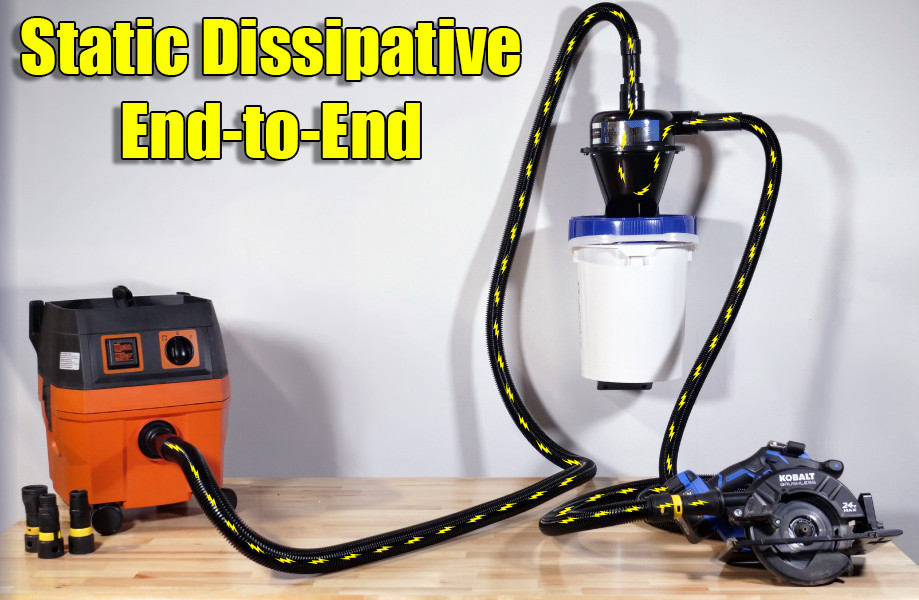
One of the most common misunderstandings about dissipative or antistatic vacuum hoses is the idea that the hose alone solves static buildup.
It would be nice if it were that simple.
A customer recently asked whether an antistatic hose would work with a Pullman-Holt 45D. On the surface, that sounds like a basic compatibility question. But the real issue had less to do with whether the hose could be attached and more to do with whether the vacuum system itself could carry static charge away.
That distinction matters.
Because when it comes to static control, a dissipative hose is only one part of the system.
The Big Misconception About Antistatic and Dissipative Hose
A lot of users assume that once they switch from a standard hose to an antistatic or dissipative hose, static shock problems should go away.
But that is only true if the charge has somewhere to go.
A dissipative hose is designed to help manage charge buildup. It is not magic. If the rest of the vacuum system isolates that charge instead of directing it toward ground, then the hose may not deliver the improvement the user expects.
In other words:
A dissipative hose can help reduce static buildup, but it still needs a path to ground to work effectively.
What a Ground Path Actually Does
As fine dust and debris move at speed through a hose, static charge can build. This is especially common in dry environments and in applications involving very fine material such as:
-
concrete dust
-
drywall dust
-
fine wood dust
-
other dry particulate
A dissipative hose helps control how that charge behaves. But for the static to be carried away, the full system has to support that process.
That means the charge needs a route through:
-
the hose
-
the fittings
-
the connected vacuum components
-
and ultimately to a grounding reference
If that chain is broken anywhere, the charge may remain trapped in the system.
Why Vacuum Construction Matters
This is where the design of the vacuum becomes important.
If a vacuum uses materials such as poly at the connection point or tank, those components may act as insulators rather than conductors.
That can create a situation where the hose is dissipative, but the vacuum it attaches to does not provide a meaningful route to ground.
That is the problem many users run into.
They upgrade the hose but still get static because the rest of the system is not helping complete the circuit.
Fitment and Function Are Not the Same Thing
This is another place where people get tripped up.
A hose may physically fit a vacuum and still not fully solve a static issue.
So when someone asks, “Will this antistatic hose work with my vacuum?” there are really two different questions hiding inside that one sentence:
-
Will it connect?
-
Will it actually help dissipate static the way I hope?
Those are not always the same answer.
A hose can connect perfectly well and still be limited by the construction of the vacuum body, inlet, canister, or accessories.
Real-World Ways Users Try to Improve Grounding
When the vacuum itself does not provide a strong grounding path, users sometimes improvise.
Two common real-world methods are:
Drop chain contacting the floor
Some users wrap the section of hose that lays on the floor with a drop chain that remains in contact with the surface during use.
This is similar to grounding techniques seen on some commercial equipment. It can help, but results depend heavily on the floor type.
-
Bare concrete can be reasonably effective
-
Sealed concrete is often much less effective
-
Insulating surfaces reduce the benefit even more
Wire wrap tied to a ground point
Another method is using a wire wrap connected to a known ground point.
This may improve grounding, but it also creates a tether, which can make the vacuum less convenient to move around. In a fixed workspace that may be fine. On a mobile jobsite, it may be a hassle.
Why Surface Conditions Matter
Even when users try to improve grounding, the surface under the vacuum matters more than many realize.
If the system relies on contact with the floor to help carry away static charge, then the conductivity of that surface becomes part of the setup.
Bare concrete behaves differently than:
-
sealed concrete
-
epoxy coatings
-
rubber flooring
-
wood flooring
-
other insulating surfaces
So two users with the same hose and same vacuum can get different real-world results depending on where they are working.
What Users Should Check Before Buying a Dissipative Hose
Before investing in a dissipative hose for static control, it helps to look at the whole system and ask a few practical questions:
-
What material is the vacuum inlet made from?
-
What material is the tank or canister made from?
-
Is there any known grounding path through the vacuum?
-
Are the accessories and fittings conductive or isolating?
-
What type of floor or work surface is involved?
-
Is the goal just hose replacement, or actual static reduction?
Those questions often tell you more than the hose spec by itself.
The Most Honest Answer
If your goal is simply to replace a hose, a dissipative hose may still be a perfectly good option.
But if your goal is to reduce static shock, then the right question is not just:
“Is this hose antistatic?”
The better question is:
“Will my full system allow this hose to dissipate charge effectively?”
That is the part that separates a good result from a disappointing one.
Final Takeaway
Dissipative and antistatic hoses are important tools, but they are only one piece of static control.
For them to work well, the system needs a real path to ground. If the vacuum body, inlet, or tank isolates the hose from ground, then the hose may not deliver the full benefit users expect.
That does not mean the hose is wrong. It means the system has to be considered as a whole.
When evaluating static control, think beyond hose diameter and fitment. Look at:
-
vacuum construction
-
connection materials
-
grounding path
-
floor conditions
-
and how the vacuum is actually being used
That full-picture view usually leads to better decisions and better performance.