
Picking the Right Diameter Hose and Length to Fit My Needs
Picking the Right Diameter Hose and Length to Fit My Needs
Choosing the right vacuum hose can be surprisingly complicated. There are different hose diameters, lengths, construction methods, hose ends, and accessories to consider. The best choice depends less on the vacuum itself and more on what you plan to pick up, where you will use the vacuum, and how often you will use it.
A hose that works well for cleaning a car may not be the best choice for a contractor working on a construction site. Likewise, a large-diameter hose that is excellent for moving high volumes of air and debris may be unnecessary for everyday garage cleaning.
Based on years of helping customers select vacuum hoses, three applications account for many of the questions we receive:
- Garage, vehicle, and general household workshop cleaning
- Contractor and jobsite use
- High-volume debris collection and specialized applications
Understanding the differences between 1.25-inch, 1.50-inch, and 2-inch vacuum hoses can make choosing the right hose much easier.
What Vacuum Hose Diameter Should I Use?
For many everyday applications, a 1.25-inch or 1.50-inch inner diameter hose provides the best combination of flexibility, airflow, and usability.
A smaller hose diameter generally provides a tighter bend radius, making the hose easier to maneuver in confined spaces. A larger diameter can move greater volumes of air and debris, but it can also be heavier, less flexible, and more difficult to maneuver.
As a general starting point:
| Hose Diameter | Best Applications | Main Advantages |
| 1.25 Inch | Cars, garages, workbenches, light-duty cleaning | Flexible, easy to maneuver, excellent for tight spaces |
| 1.50 Inch | Contractors, workshops, power tools, general commercial use | Good balance of airflow, durability, and flexibility |
| 2 Inch | High-volume debris, dust separators, heavy-duty applications | Moves larger volumes of air and debris |
| 2.50 Inch | Specialized high-volume applications | High air volume, typically less flexible |
The important thing is not simply choosing the largest hose you can connect to your vacuum. The hose diameter should match the vacuum's performance and the material you are trying to collect.
Choosing a Vacuum Hose for Your Garage and Car
One of the most common questions we hear is:
“I have a shop vacuum in my garage. What hose should I use for my car, garage floor, and workbench?”
For this type of homeowner application, we generally recommend a 1.25-inch inner diameter vacuum hose.
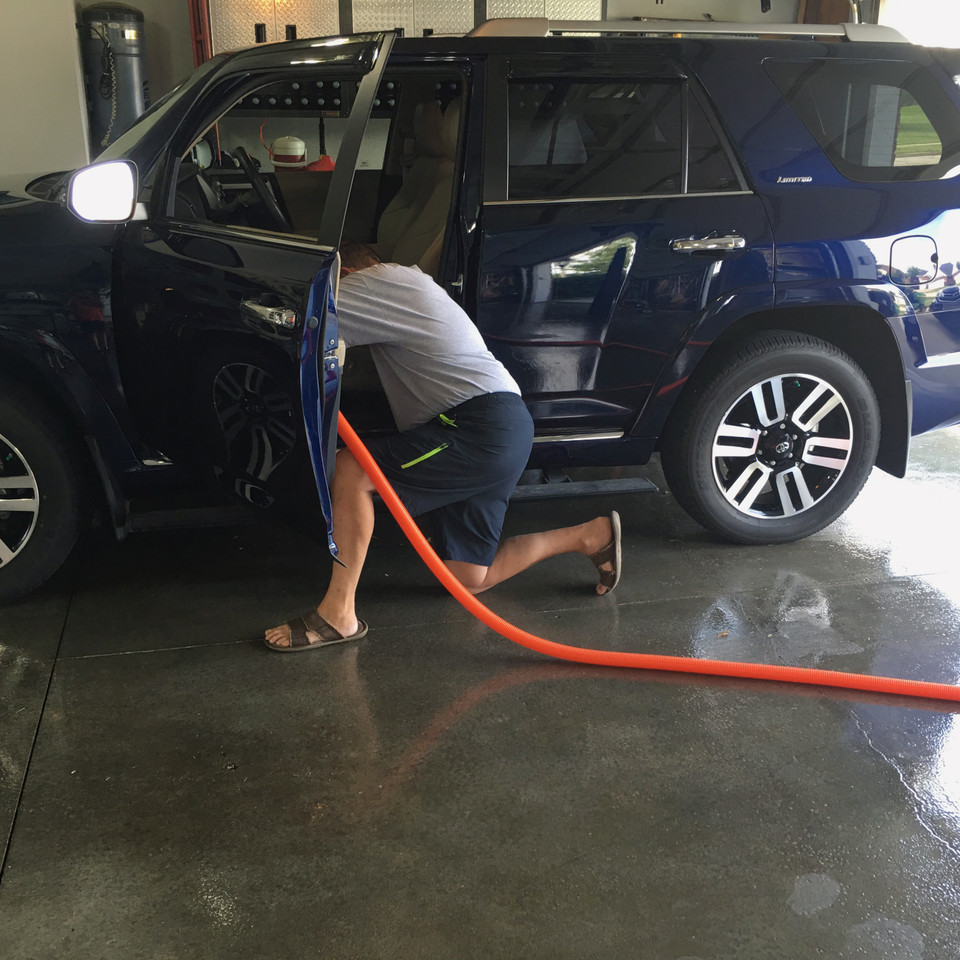
A 1.25-inch hose is particularly useful when cleaning vehicles because it is flexible and can maneuver into tight spaces. Getting underneath the front seats, around the center console, or into other confined areas is much easier with a hose that can bend without constantly fighting against you.
The smaller diameter also means a smaller bend radius. This makes the hose easier on your hands, wrists, and forearms during extended cleaning.
A 1.25-inch hose also works well around a cluttered workbench. You can maneuver the hose around tools and other objects without having to wrestle with a large, stiff hose.
Look for a Crush-Resistant Hose in the Garage
Garage hoses can experience more abuse than expected. A hose can accidentally be left underneath a vehicle tire, rolled over by a bicycle, or crushed by equipment.
For this reason, a crush-resistant or crush-proof hose is a worthwhile upgrade for garage use.
Look for a Smooth Interior
The inside of the hose matters just as much as the outside.
Many hoses supplied with household shop vacuums are vacuum formed and have a corrugated or relatively rough interior. These ridges can interfere with airflow and provide places where debris can catch.
A spiral-wound hose with a smooth interior can provide better airflow and reduce the opportunity for debris to become trapped inside the hose.
Consider a Swivel Hose End
A swivel hose end is another useful feature, particularly when cleaning vehicles or working around a workbench.
As you move the hose and vacuum tool, a swivel allows the connection to rotate rather than forcing the hose to twist. This helps reduce kinking and makes the tool easier to position.
A 1.25-inch hose also has the advantage of having a large selection of compatible accessories, including:
- Crevice tools
- Upholstery tools
- Dusting brushes
- Floor brushes
- Wet-dry squeegees
- Power tool dust collection adapters
- Vehicle cleaning accessories
Because 1.25-inch is a common size in the vacuum industry, these accessories are also often relatively economical.
How Long Should a Garage Vacuum Hose Be?
Many household shop vacuums come with hoses around 5 to 7 feet long. While this may be adequate for small jobs, it can be inconvenient for cleaning a vehicle.
With a short hose, the vacuum often needs to sit beside the vehicle or partially inside a door opening. This can obstruct access and require you to move the vacuum repeatedly.
We generally consider 10 feet a practical minimum, but 16 feet is a good all-around length for vehicle and garage cleaning.
A 16- to 20-foot hose can allow the vacuum to remain behind the vehicle while you work from the front seats to the trunk without continually moving the vacuum.
If the vacuum is mounted on a wall or stored on a shelf and you want to avoid moving it, a 30-foot hose may be more appropriate.
For a large garage or extended workspace, a 50-foot hose may make sense.
Consider How the Hose Will Be Stored
Longer hoses require more thought about storage.
A hose of approximately 20 feet or less can often be stored in a mesh bag along with many of its accessories. Longer hoses may be easier to manage with a wall-mounted hose hanger.
If using a hose hanger, install it high enough to minimize the number of loops required. For example, a mounting height of approximately 5 to 6 feet can allow a 30-foot hose to be stored in roughly three large loops and a 50-foot hose in roughly five.
Larger loops also use less horizontal wall space.
Choosing a Vacuum Hose for Contractors and Jobsites
Contractors have very different requirements from the average homeowner.
A contractor may use the same vacuum at a remodel, new construction project, finished basement, bathroom, workshop, or other jobsite. The hose needs to handle changing conditions while surviving frequent use.
For this type of application, a 1.50-inch inner diameter hose is an excellent starting point.
A 1.50-inch hose provides a good balance between flexibility, durability, and airflow. The larger inner diameter compared with a 1.25-inch hose also helps move debris back to the vacuum.
Choose a Crush-Resistant, Smooth-Interior Hose
Contractors should look for a hose designed to withstand daily jobsite use.
A crush-resistant or crush-proof hose can withstand the inevitable abuse that occurs around construction materials, tools, and equipment.
A spiral-wound hose with a smooth interior is also preferable when collecting larger debris. The smoother interior helps maintain airflow and reduces the likelihood of debris catching inside the hose.
Wet-dry capability is another important consideration. Construction and remodeling projects may require collecting water or slurry, such as when wet cutting concrete to control dust.
Swivel Hose Ends Reduce Fatigue
Contractors spend a lot of time manipulating vacuum hoses and tools. A swivel hose end allows the hose to rotate as the tool moves rather than twisting the hose itself.
This can reduce stress on both the hose and the person using it.
For everyday professional use, the accessories designed for 1.50-inch systems are also generally more durable than many domestic vacuum accessories. While they may cost more, their durability can save time and replacement costs over the life of the equipment.
A 1.50-inch hose can also be paired with power tool dust collection adapters, allowing tools such as sanders and miter saws to connect directly to the vacuum.
How Long Should a Contractor's Vacuum Hose Be?
Many commercial and contractor vacuums are supplied with hoses around 10 feet long.
While 10 feet may be adequate for some applications, it often means the vacuum must be moved repeatedly around the jobsite.
We generally recommend starting with a 20-foot hose for contractor applications, with 15 feet being a good second choice.
A 15-foot hose can provide enough reach to work across a substantial area without constantly moving the vacuum. A 20-foot hose provides even more freedom while keeping the vacuum relatively close to the work area.
For overhead work or situations where you want to keep the vacuum away from the immediate workspace, a 30-foot hose may be a better choice.
A 50-foot hose is generally reserved for specialized situations where the vacuum cannot be positioned near the work area, such as certain crawl-space or attic applications.
The goal is to keep the vacuum as stationary as practical. Dragging a vacuum through a workspace full of tools and construction materials takes time and can increase wear on both the vacuum and the operator.
What About a 2.50-Inch Shop Vacuum Hose?
If your shop vacuum came with a 2.50-inch hose, you may wonder whether you should simply replace it with another hose of the same diameter.
The answer depends on what you use the vacuum for.
Large-diameter hoses are designed to move a greater volume of air and can be useful for applications involving large amounts of debris. However, many 2.50-inch hoses supplied with household shop vacuums are vacuum formed or blow molded and have a rough or corrugated interior.
Wire-supported hoses are another common construction at this size and can also have a corrugated interior.
A rough interior can create additional airflow resistance compared with a smoother hose.
Airflow vs. Water Lift
One of the most important concepts to understand when selecting a vacuum hose is the difference between airflow and water lift.
Water lift is a measure of the vacuum's ability to generate suction. It helps determine how effectively the vacuum can pick up material.
Airflow is the movement of air through the vacuum system. It helps carry the collected material through the hose and back to the collection container.
A larger hose diameter can help move a greater volume of air and larger pieces of debris. However, simply installing a larger hose does not automatically make a vacuum more powerful.
The vacuum needs to have enough performance to take advantage of the larger diameter.
When Does a 2-Inch Vacuum Hose Make Sense?
A 2-inch hose can be an excellent choice when the application involves large volumes of debris or material that could clog a smaller hose.
Examples include:
- Dust separators
- Planers
- Shapers
- Demolition work
- Large debris collection
- Wet leaf collection
- Specialized industrial applications
If you are collecting large debris such as plaster or insulation during demolition, a larger hose can help reduce clogging.
A 2-inch hose can also be useful when connecting a vacuum to equipment that generates large amounts of material.
However, for everyday tasks such as cleaning a vehicle, vacuuming a garage floor, or cleaning a workbench, a 2-inch hose is often more hose than necessary.
For these applications, 1.25-inch or 1.50-inch hose is generally easier to handle and more practical.
Does a Large Hose Require a More Powerful Vacuum?
Yes, the vacuum's performance should be considered when moving to a larger hose.
Large-diameter hoses are most useful when the vacuum can provide sufficient airflow to take advantage of the increased capacity.
For high-volume applications, a high-performance vacuum—often a two-motor commercial unit producing approximately 200 CFM—may be appropriate.
For example, collecting wet leaves from gutters can benefit from a high-performance vacuum paired with a 2-inch hose.
Likewise, truck-mounted carpet extraction equipment commonly uses 2-inch hose because the equipment is specifically designed to provide the airflow and suction required for that hose diameter and length.
What Is the Best Vacuum Hose Diameter for Your Application?
There is no universal “best” vacuum hose size. The right choice depends on what you are collecting, the environment, and how much maneuverability you need.
Choose a 1.25-Inch Hose If:
- You primarily clean vehicles
- You vacuum your garage occasionally
- You clean workbenches and work areas
- You need excellent flexibility
- You frequently work in tight spaces
- You want a broad selection of affordable accessories
Choose a 1.50-Inch Hose If:
- You are a contractor or professional user
- The vacuum is used frequently
- You collect larger debris
- You use power tools with dust collection
- You need a balance of flexibility and airflow
- You work in changing environments
- You need a durable wet-dry hose
Choose a 2-Inch Hose If:
- You collect large volumes of debris
- You use a dust separator
- You operate equipment such as planers or shapers
- You perform demolition work
- You need to reduce clogging from large debris
- Your vacuum has enough performance to support the larger hose
Choosing the Right Vacuum Hose Length
Hose diameter isn't the only decision. Length can have just as much impact on how easy a vacuum is to use.
As a general guideline:
| Application | Recommended Diameter | Typical Useful Length |
| Vehicle and garage cleaning | 1.25 Inch | 16–20 feet |
| Wall-mounted garage vacuum | 1.25 Inch | 30 feet |
| Large garage/workspace | 1.25–1.50 Inch | 30–50 feet |
| Contractor/jobsite use | 1.50 Inch | 15–20 feet |
| Overhead or remote jobsite work | 1.50 Inch | 30 feet |
| Crawl spaces and attics | 1.50–2 Inch | Up to 50 feet |
| High-volume debris collection | 2 Inch | Application dependent |
| Specialized extraction systems | 2 Inch | Equipment dependent |
These are starting points rather than hard rules. A longer hose provides greater reach but also increases the demands placed on the vacuum system. The vacuum must have sufficient performance to maintain effective airflow and suction through the added length.
The Best Vacuum Hose Is the One That Matches the Job
When choosing a vacuum hose, it can be tempting to focus only on the diameter that came with the vacuum. But the original hose is not necessarily the best hose for the way you actually use the machine.
For most homeowners, a 1.25-inch hose provides excellent flexibility and maneuverability for vehicles, garages, and workbenches.
For contractors and frequent professional users, a 1.50-inch hose provides a useful balance of airflow, durability, and flexibility.
For high-volume debris collection and specialized applications, a 2-inch hose can provide the additional capacity needed to move larger amounts of material while reducing clogging.
Beyond diameter, pay attention to hose construction, interior smoothness, crush resistance, length, and hose-end design. A smooth-interior spiral-wound hose and swivel hose end can make a noticeable difference in everyday use.
The goal isn't to choose the biggest hose. It is to choose the right combination of diameter and length for your vacuum and the work you actually do.