
Customer Question: Will a Cen-Tec Quick Click Hose Fit a Milwaukee Shop Vacuum or a Dust Deputy?
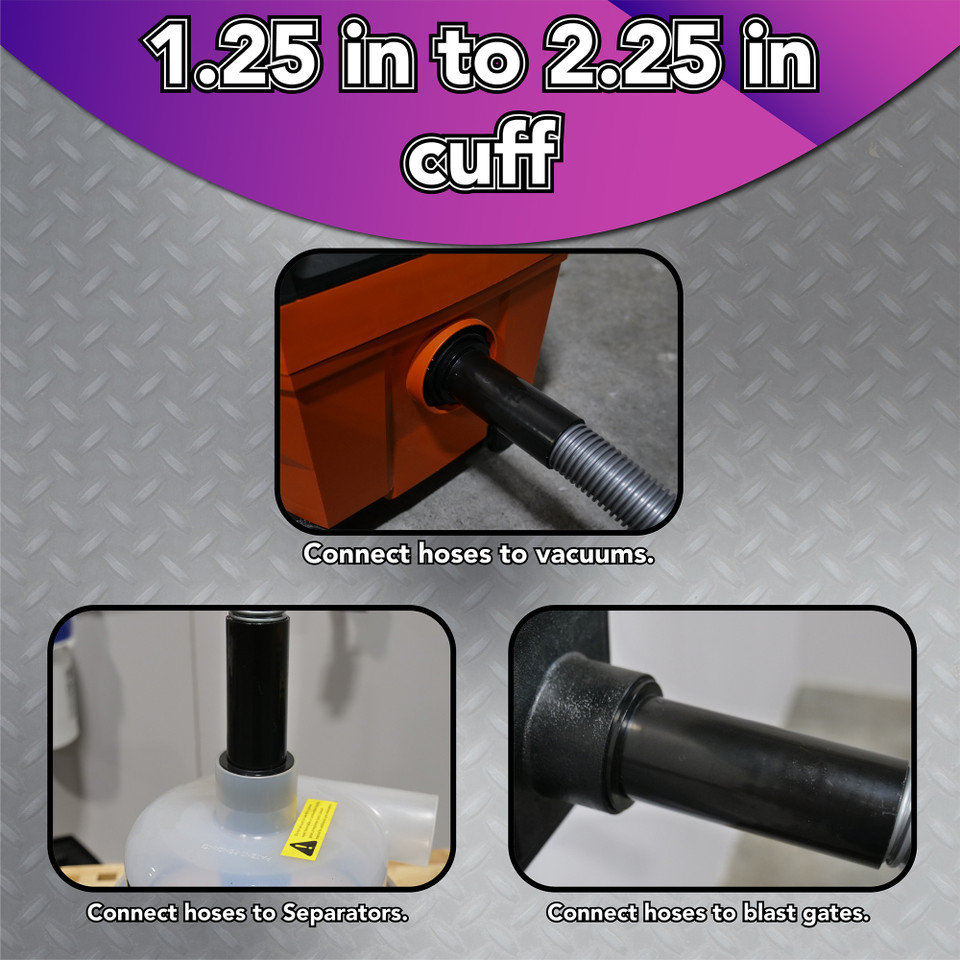
One of the most common questions we get is some version of this:
“I bought your hose kit, but it does not seem to fit my shop vacuum. Do you sell a larger diameter version?”
That sounds simple, but in real life it usually is not.
The problem is that “shop vac” is not one standard size. Even within the same brand, different vacuums can use different inlet diameters. Add in a Dust Deputy or other separator, and now you may be working with more than one connection point in the same setup.
That is exactly why fit questions need a little more detail before anyone can give a good answer.
The Real Issue Is Usually the Port Size, Not the Hose
When someone says a hose does not fit a Milwaukee vacuum, the first thing we need to know is which Milwaukee vacuum they have and what the inner diameter of the tank opening actually measures.
For example, we have a Milwaukee FUEL vacuum in our library with a tank opening that measures roughly 2.5 inches inside diameter. For that version, the right solution is not a completely different hose. It is the correct adapter.
In that case, the adapter is 62909. That part fits male into the 2.5-inch opening on the Milwaukee FUEL version we have, and it works with the standard end used on our 1.25-inch Quick Click hoses.
That is an important distinction. A lot of people assume they need a larger hose, when what they really need is the correct adapter between the vacuum and the hose system.
What About the Dust Deputy?
The same thing happens with dust separators.
On the traditional Dust Deputy, the opening going male into the separator from the hose side measures about 1.75 inches in diameter. For that application, the right part is 34982.
The nice thing about the 34982 is that it allows a 1.25-inch Quick Click hose to connect into that opening while preserving the 1.25-inch inner diameter through the connection. In plain English, that means you are not creating an unnecessary internal ledge right where debris is trying to pass through.
That matters more than people think. A sloppy transition can interrupt airflow and make debris flow less smooth, especially with larger chips and heavier dust.
Why One Answer Does Not Fit Every Vacuum
This is where customers get frustrated, and honestly, it makes sense.
A person may try one hose kit on several different vacuums and assume the hose is the problem. But the real issue is that each vacuum may use a different style opening.
Some smaller toolbox-style units take a male 1.75-inch connection similar to a Dust Deputy. Some take a 1.25-inch male fitting. Some full-size shop vacs, including some models from other brands, may use larger openings around 2.63 inches.
That is why we usually ask for more detail before recommending a part number. “Milwaukee vacuum” is not enough by itself. Neither is “shop vac.” The exact model and the measured inner diameter of the opening tell the story.
A Good Fit Starts With Measuring
If you are trying to connect a Quick Click hose to a vacuum or separator, the best first step is simple:
Measure the inner diameter of the port you are trying to fit into.
That one measurement saves a lot of guessing.
Once you know the opening size, it becomes much easier to identify whether you need:
- A direct adapter for the tank opening
- A connector to join standard 2.25-inch shop vacuum ends
- Or a cuff that adapts a 1.25-inch hose to a 1.5-inch or 1.75-inch style opening
The Bigger Takeaway
Most of the time, the answer is not “you need a bigger hose.”
The answer is usually that you need the right adapter to match the vacuum or separator you already have.
That is especially true when you are trying to connect a dust collection hose system like Quick Click to shop vacuums, separators, and tool ports that were never designed around one universal standard.
The good news is that there is often a solution. The bad news is that it usually starts with a tape measure.
Need Help Matching Your Vacuum?
If you are not sure what adapter you need, send us the vacuum model and the inside diameter of the port you are trying to connect to. Photos help too.
Once we know what opening you are working with, we have a much better chance of getting you to the right solution the first time.